SOURCE CHECKS
Repository integrity
Static gates check source conventions, tooling, workflow configuration and test-data contracts. They do not execute Excel or certify regulatory calculations.
Read the check definitions ↗K-SFTs / Counterparty credit risk
Securities financing transactions, explained through an open-source Excel/VBA prototype.
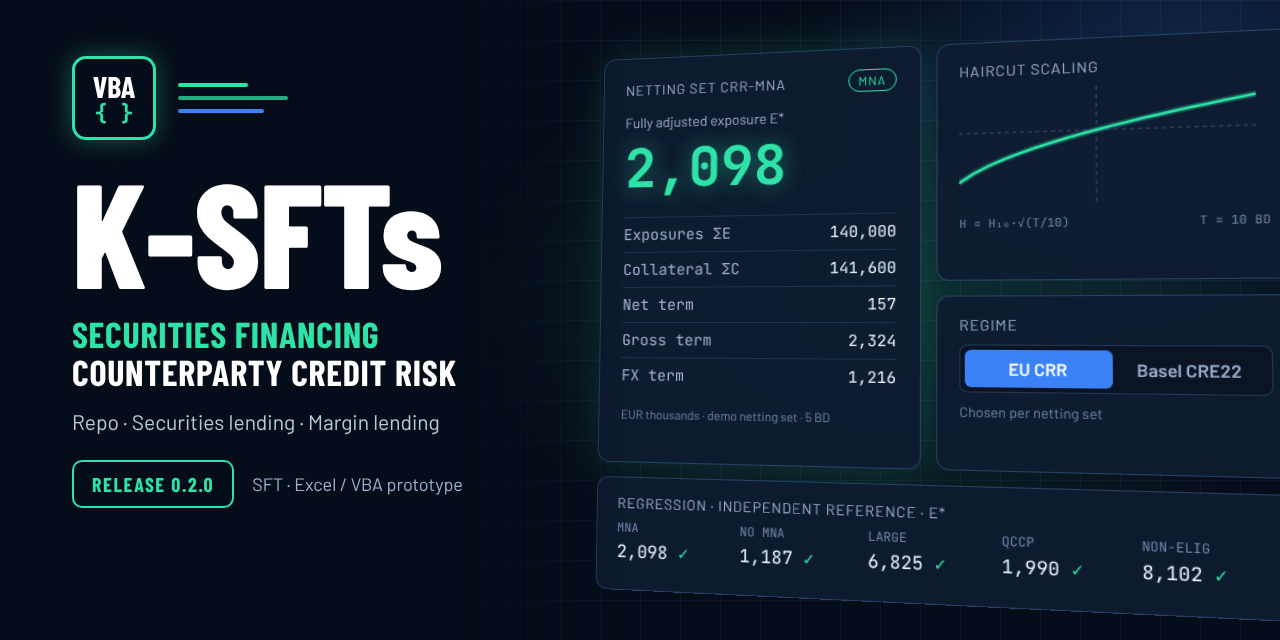
Inspect transactions, supervisory haircuts and netting-set results. Follow the calculation from the assets given and received to the fully adjusted exposure value, E*.
01 / The calculation
The prototype covers repos and reverse repos, securities lending and borrowing, and margin lending. Its financial collateral comprehensive method makes the exposure and collateral adjustments visible.
Record cash and securities given or received, link the legs to transactions, and assign transactions to their netting sets.
Use the collateral classification, holding period and applicable currency adjustment. Inspect the parameters and the assumptions behind them.
Calculate E* under an eligible master netting agreement, or calculate each transaction separately and sum the results.
The EU CRR controls the intended methodology, with the Basel Framework as reference. The prototype computes under the CRR only; only E* is supported, and the risk weight, RWA and own funds are illustrative (support matrix). The outputs above describe the prototype, not a complete bank capital framework.
02 / The wider framework
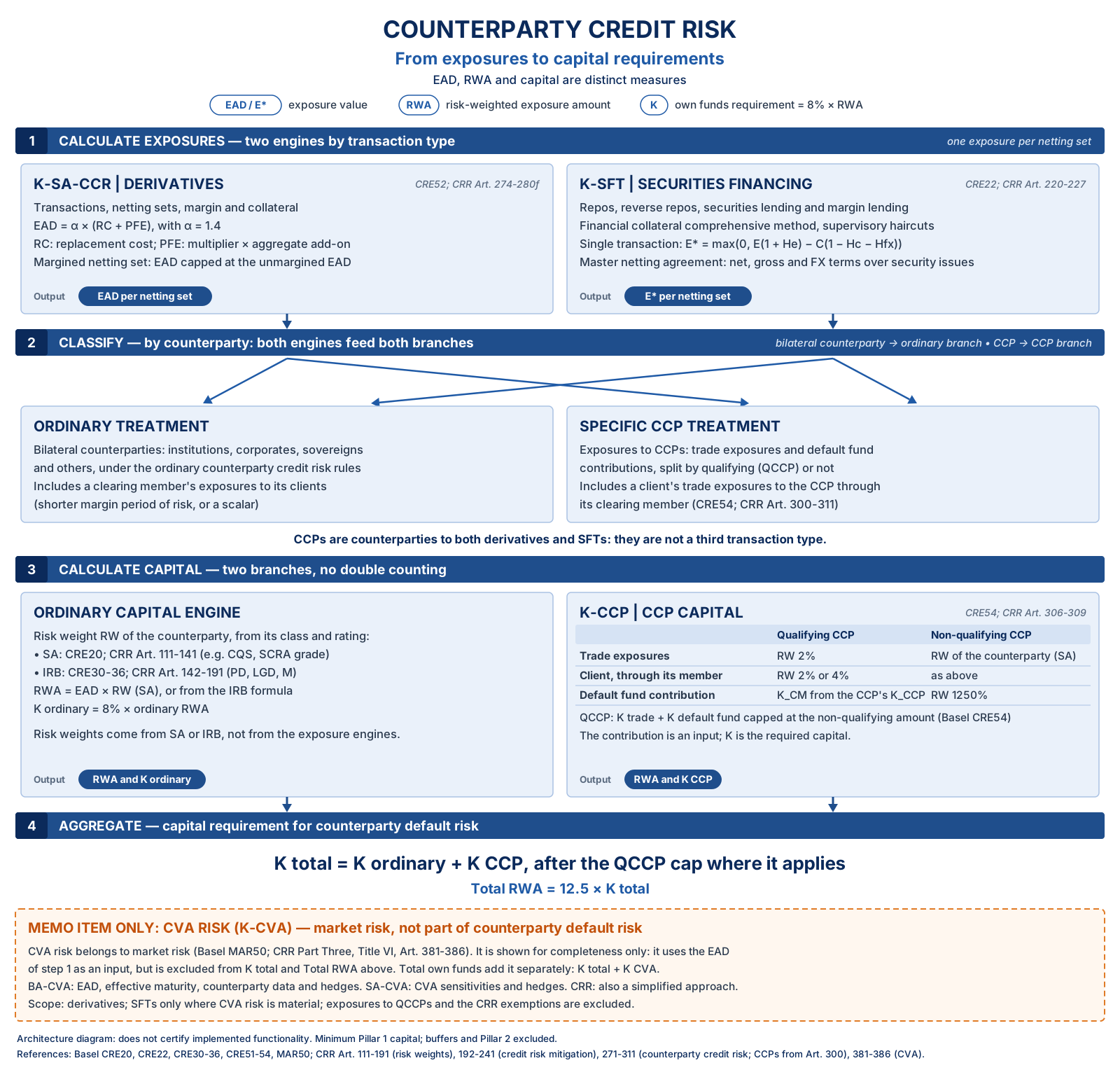
K-SFTs provides the securities financing exposure component. The prototype also calculates standardised risk-weighted exposure and own funds per netting set, including a QCCP trade-exposure class. Default-fund capital and CVA are not implemented here.
03 / Get started
A Git clone preserves the checkout conventions expected by the VBA editor.
git clone --branch release/0.3.0 https://github.com/danielep71/K-SFTs.git
cd K-SFTsStart from the macro-free template and import the exported VBA using the documented setup. Compile and run the checks in desktop Excel for Windows.
The repository does not distribute a released macro-enabled workbook.
Open the installation guide ↗04 / Evidence and boundaries
SOURCE CHECKS
Static gates check source conventions, tooling, workflow configuration and test-data contracts. They do not execute Excel or certify regulatory calculations.
Read the check definitions ↗HOST & NUMERICAL EVIDENCE
Inspect the documented Excel host runs, harness evidence and independent reference. Each record applies to its stated scope and revision.
Read the Excel evidence ↗Explore the test structure ↗OPEN WORK
The supported scope is decided; each supported rule still has to be traced to the CRR and tested. Implementation and test results do not establish regulatory validation.
Read the methodology of record ↗Follow open work ↗Open source / Open to inspection