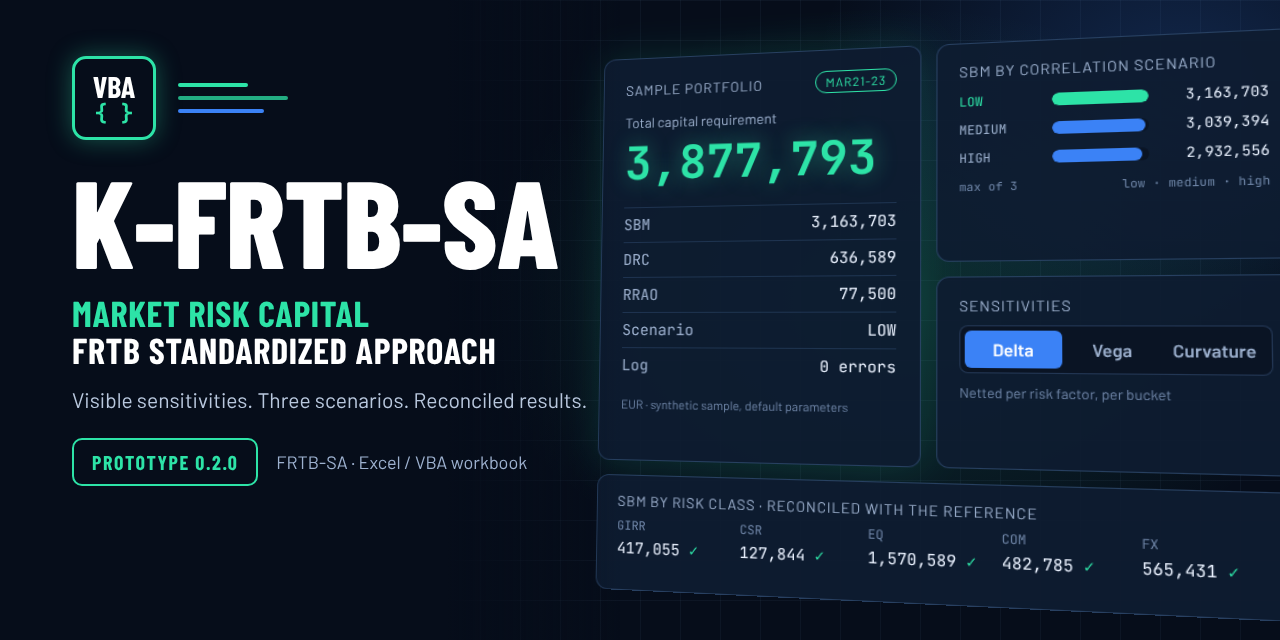
A transparent implementation of the FRTB standardized approach.
Follow market risk inputs through sensitivities, default risk and residual risk to a capital requirement. Inspect the calculation and its intermediate results in an open-source Excel/VBA prototype.
K-FRTB-SA supports benchmarking, model challenge, research and education. Sensitivities and positions are inputs; the prototype makes netting, weighting and aggregation visible.
Capital = SBM + DRC + RRAO
01 / Sensitivities
Sensitivities-based method
Delta, vega and curvature across general interest rate risk, non-securitization credit spread risk, equity, commodity and foreign exchange risk.
Aggregate across risk classes under low, medium and high correlation scenarios, then take the largest total.
02 / Default
Default risk charge
Non-securitization jump-to-default exposures, with maturity scaling, obligor netting by seniority and a hedge benefit ratio for each bucket.
Inspect net exposures and bucket contributions in the workbook outputs.
03 / Residual risk
Residual risk add-on
A separate add-on for instruments bearing exotic or other residual risks, based on the applicable gross notional amounts.
Keep residual risk contributions distinct from SBM and DRC.
The prototype uses the Basel MAR21–MAR23 framework. Securitization and correlation trading portfolio coverage are outside the current prototype. Check the full scope ↗
02 / Inside the workbook
Every step leaves an explanation.
01 / INPUT
Provide risk inputs
Enter sensitivities and positions. Unknown classifications and invalid amounts are rejected and logged with their reasons.
02 / CALCULATE
Inspect the assumptions
Review risk weights and correlations on the parameter sheets, alongside their Basel paragraph references.
03 / RECONCILE
Follow the outputs
Inspect bucket-level results, default risk netting and the final totals. Compare outputs with the independent reference.
Use a Git clone to preserve the VBA checkout conventions. Current prototype development uses the integration branch below.
git clone --branch release/v0.2.0 https://github.com/danielep71/K-FRTB-SA.git
cd K-FRTB-SA
2. Follow the Windows build guide
The repository contains a macro-free template and exported VBA modules. The PowerShell build script assembles the macro-enabled workbook locally; the template alone does not run the engine.
The project documents hand-calculated formula tests, an independent Python reference, headless LibreOffice runs of the VBA and static source checks. These establish different kinds of evidence; they do not substitute for Excel host testing or regulatory validation.
Excel compilation and runtime evidence, the final platform decision and broader methodology decisions remain tracked in the repository. Consult the live issue tracker for current progress.